















ICMR-NIN: 1 in 5 Pregnant Women Face Vitamin B1 Deficiency
19 Nov, 2026 13:48 IST|Sakshi Post


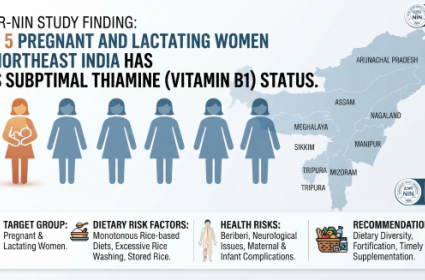
1 in 5 women: Approximately 20% of pregnant and lactating women surveyed had suboptimal Vitamin B1 status.
Study population: 1,083 women across 120 villages in Assam and Tripura.
Study period: 2023–2024.
ThDP findings: 4.9% had deficiency and 15.2% had marginal status.
ETKAC findings: 8.5% had severe and 12.1% had marginal deficiency.
Higher risk: Pregnant women showed a higher prevalence than lactating women.
Dietary concerns: Rice-based diets, repeated rice washing, stored rice, betel nut consumption and salted tea were associated with increased odds of deficiency.
Recommendations: Dietary diversity, nutritional surveillance and timely supplementation in high-risk regions.
A recent study by researchers from the Indian Council of Medical Research–National Institute of Nutrition (ICMR-NIN), Hyderabad, has raised concerns over the prevalence of Vitamin B1 (thiamine) deficiency among pregnant and lactating women in parts of Northeast India. The study found that approximately one in five women surveyed had suboptimal thiamine status, highlighting the need for greater attention to micronutrient deficiencies in maternal nutrition.
Published in the Annals of the New York Academy of Sciences, the study titled “Re-Emergence of Thiamine Deficiency Among Pregnant and Lactating Women in Northeast India” examined women in Assam's Barak Valley and adjoining districts of Tripura, regions where beriberi cases have been reported previously.
The community-based cross-sectional study was conducted during 2023–2024 across 120 villages and involved 1,083 pregnant and lactating women.
One in five women had suboptimal Vitamin B1 levels
Researchers assessed thiamine status using two methods: whole-blood thiamine diphosphate (ThDP), a biochemical marker, and the erythrocyte transketolase activation coefficient (ETKAC), a functional indicator of thiamine status.
The ThDP assessment found that 20.1% of women had suboptimal thiamine status. This included 4.9% with deficiency and 15.2% with marginal status.
The ETKAC assessment showed a comparable prevalence of 20.6%, comprising 8.5% with severe and 12.1% with marginal thiamine deficiency.
The study also found a higher prevalence among pregnant women compared with lactating women, indicating the importance of monitoring nutritional status during pregnancy.
Rice-based diets and food practices among risk factors
According to the researchers, dietary assessments revealed that women predominantly consumed rice-based diets with limited dietary diversity.
ICMR-NIN scientist Dr Mahesh Kumar Mummadi, who led the study, said several food-related practices were associated with increased odds of thiamine deficiency. These included consuming stored rice, repeatedly washing rice before cooking, betel nut consumption and drinking salted tea.
Socioeconomic disadvantage was also associated with an increased risk of inadequate thiamine status.
The findings suggest that dietary monotony and certain food preparation practices may contribute to inadequate Vitamin B1 intake, particularly in vulnerable communities.
Why is Vitamin B1 important during pregnancy?
Thiamine, also known as Vitamin B1, is an essential micronutrient involved in energy metabolism and the normal functioning of the nervous system. Deficiency can have serious health consequences, making adequate intake important for maternal and infant health.
ICMR-NIN Director Dr Bharati Kulkarni emphasised the need to pay greater attention to micronutrients beyond those routinely addressed in maternal nutrition programmes.
The researchers recommended improving dietary diversity, strengthening nutritional surveillance and providing timely supplementation in high-risk regions.
ICMR-NIN's historical connection with beriberi research
The findings have particular significance for ICMR-NIN, whose origins date back to 1918, when it began as the Beri-Beri Enquiry Unit to investigate thiamine deficiency.
The institute continues to work on persistent and emerging nutritional challenges, with a focus on translating scientific research into effective public-health interventions.
However, the researchers cautioned that the study was conducted in regions with previously documented suspected beriberi clusters. Therefore, its findings should not be generalised to all pregnant and lactating women across India.
